

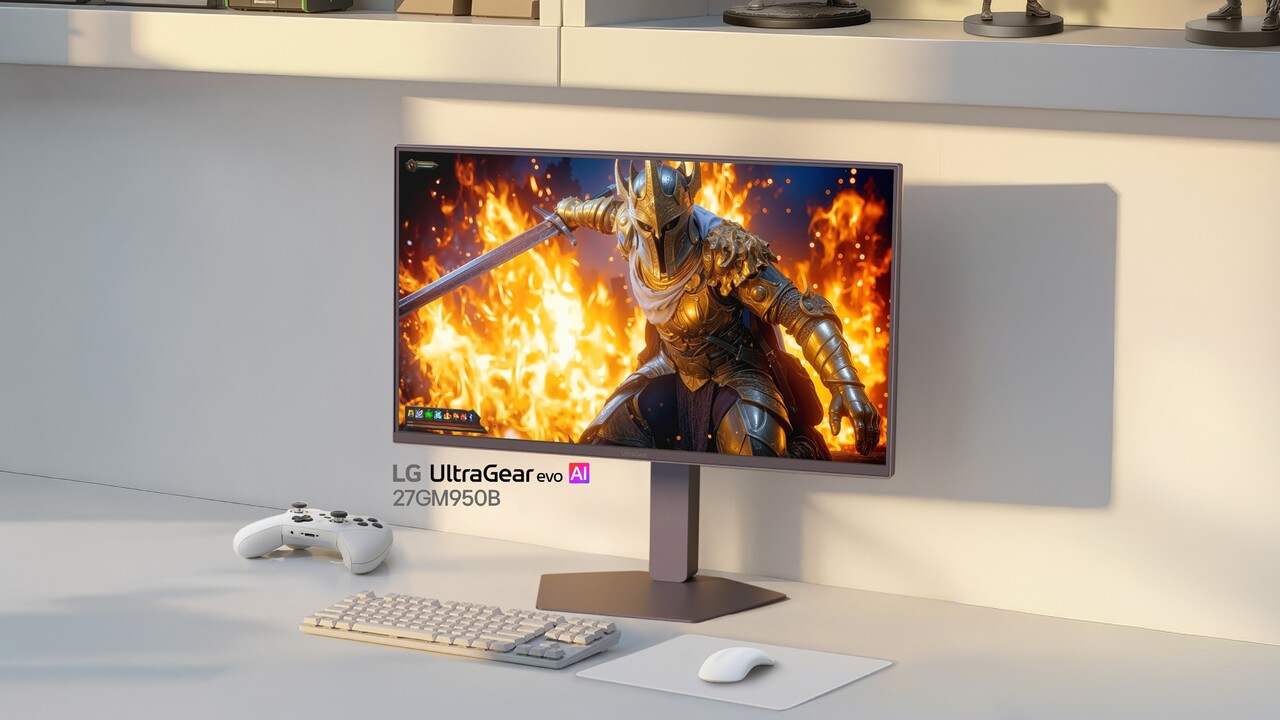
LG wants to install the particularly bright WQHD tandem OLED panel with 480 Hz in its own monitor and at the same time announces a 5K monitor with 165 Hz and 2,304 mini LED zones. The 27″ WQHD tandem OLED is to go on sale at CES 2026 in January (topic), the 5K monitor will be shown for the first time.
Term Signposts LG UltraGear 480 Hz OLED launch & 5K monitor
Since the terms around “5K” or “5K2K” quickly cause confusion and, above all, too little overview of the actual theoretical image sharpness (in ppi), the following table should allow a quick classification. The editors have selected the most well-known resolutions and display sizes, so that the table can create a quick comparison to your own monitor. A higher pixel density means a sharper image, while maintaining the same distance. The resolutions discussed in the article are highlighted in color.
Comparison of selected display resolutions
| resolution | aspect ratio | pixel count | Display size | Pixel density (ppi) |
|---|---|---|---|---|
| 7680 × 4320 (8K UHD) | 16:9 | 33.18 million | 32 inches | 275 ppi |
| ~ 6,144 × 3,456 (6K) | 16:9 | 21.23 million | 32 inches | 224 ppi |
| 5120 × 2880 (UHD+ / 5K) | 16:9 | 14.75 million | 27 inches | 218 ppi |
| 5120 × 2160 (WUHD / 5K2K) | 21:9 | 11.06 million | 39.7 inches | 140 ppi |
| 52 inches | 110 ppi | |||
| 3840 × 2160 (4K UHD) | 16:9 | 8.29 million | 31.5 inches | 140 ppi |
| 27 inches | 163 ppi | |||
| 5120 × 1440 (DQHD) | 32:9 | 7.37 million | 44.5 inches | 120 ppi |
| 3440 × 1440 (UWQHD) | 21:9 | 4.95 million | 34 inches | 110 ppi |
| 2560 × 1440 (QHD) | 16:9 | 3.67 million | 27 inches | 109 ppi |
| 31.5 inches | 93 ppi | |||
| 2560 × 1080 (WFHD) | 21:9 | 2.76 million | 29.5 inches | 94 ppi |
| 1920 × 1080 (FHD) | 16:9 | 2.07 million | 27 inches | 82 ppi |
| 24 inch | 92 ppi |
LG UltraGear evo 27″ GM9 (27GM950B)
The year 2026 is already about to become interesting for gamers: new OLED monitors are now part of the norm every year, but the GM950B now also heralds higher resolutions for gamers with a resolution of 5,120 × 2,880 (5K) at a refresh rate of 165 Hz. Samsung has also already announced 5K and 6K gaming monitors. They are also expected to attend CES in January.
New AI functions are added that analyze and “improve” the image locally before it is displayed. There is also AI sound and another AI image enhancement.
| LG UltraGear evo 27″ GM9 (27GM950B) | |
|---|---|
| Panel type | LCD |
| with 2,304 mini LED zones | |
| diagonal | 27 inches |
| resolution | 5120 × 2880 (5K) |
| aspect ratio | 16:9 |
| Pixel density | 218 ppi |
| refresh rate | 165 Hz (5K) 330 Hz (QHD) |
| HDR | VESA DisplayHDR 1000 |
| Brightness (APL) | min. 1,000 cd/m² (100%) and 1,000 cd/m² (10%), 1,250 cd/m² (peak) |
| Special feature | 1500R curved, AI functions |
2,304 Mini-LED Zones Call the Fight to Blooming
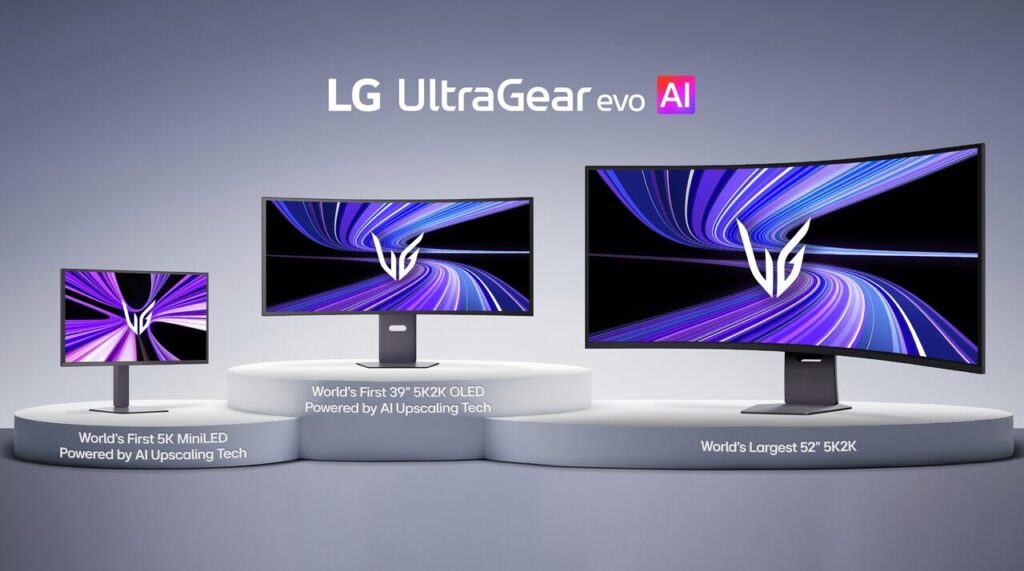
The panel does not rely on organic light-emitting diodes, but on an LCD with mini-LED zones. LG wants to have the often occurring problem of blooming “solved” and installs 2,304 individually controllable zones. This is a lot compared to the (own) competition, even unique for 5K. Many monitors with less resolution or more display size only come to 1,152 or even 576 zones in a price comparison. However, a test must first show whether the higher zone density is really sufficient here to have “solved” the radiation of brightness into dark areas.
Thanks to the backlight, the monitor is certified according to VESA DisplayHDR 1000 and should reach up to 1,250 cd/m2 at the top. Since it is not an OLED panel, according to the specification, even 1,000 cd / m2 can be expected over the entire area.
More monitors from LG UltraGear Evo
LG has also introduced two curved monitors in 39″ and 52″, each with a resolution of 5K2K (5,120 × 2,160), which also belong to the new LG UltraGear Evo series. The editorial staff has summarized the details in a separate article.
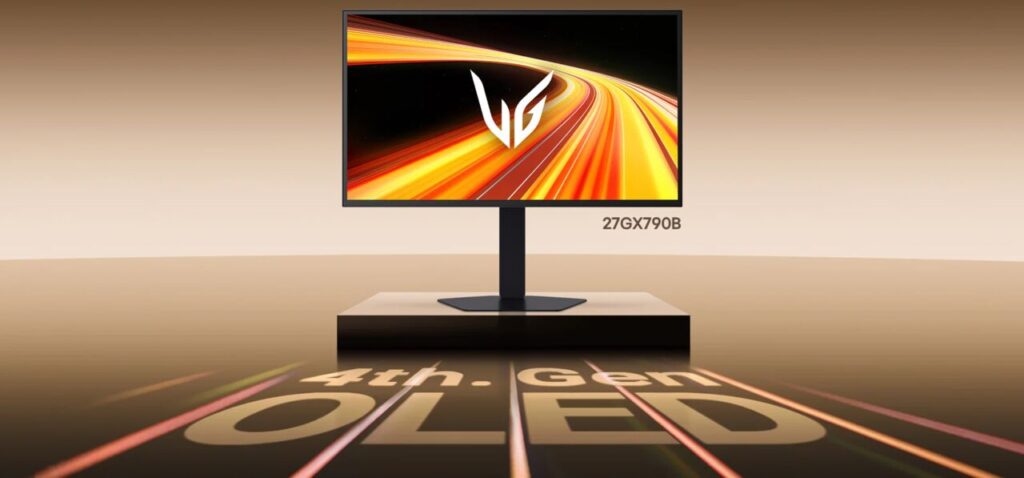
LG UltraGear GX7 (27GX790B) glatze lieferbar
Kein Teil der neuen Evo-Serie, aber auch bisher nicht im Handel erhältlich, ist der GX790B. Der Monitor richtet sich mit neuestem Tandem-OLED bei 27″ und WQHD-Auflösung (2.560 × 1.440) an Gamer, die von hohen Auflösungen noch Abstand nehmen, um höhere Bildraten zu erreichen.
Im Gegensatz zu dem vor einem Jahr vorgestellten Bruder GX790A verbaut LG nun ein neues Panel mit bis zu 540 Hertz bei natürlicher Auflösung und einer höheren Helligkeit. Dank Dual-Modus sind auch 720 Hz möglich, wenn die Auflösung auf HD oder 1.280 × 720 Pixel abgesenkt wird. Die Pixeldichte sinkt hier dann übrigens auf 54 ppi.
Tandem OLED with higher brightness
The new panel of the GX790B was recently tested by the editors during the review of the Asus ROG Swift OLED PG27AQWP-W. Tandem-WOLED was able to shine much brighter than previous generations. LG confirms with the brightness values on an overview page that the brightness of the tested Asus ROG is achieved.
However, the GX790B does not rely on the new RGB OLED from LG Display without the white pixel from WOLED. Although the monitor is already listed in the price comparison, it is not yet available. LG wants to make up for that at CES now.
Overview of the technical specifications of the UltraGear 27GX790B
| LG UltraGear GX7 (27GX790B) | |
|---|---|
| Panel | Tandem WOLED |
| diagonal | 27 inches |
| resolution | 2560 × 1440 (WQHD) |
| Pixel density | 111 ppi |
| refresh rate | 540 Hz (native) 720 Hz (HD) |
| HDR | DisplayHDR True Black 500 |
| Brightness (APL) | 335 cd/m² (100%), 800 cd/m² (10%), 1500 cd/m² (1.5%) |
| color space | 99.5% DCI-P3 |
| FreeSync/G-Sync | FreeSync Premium Pro + G-Sync compatible |
| aspect ratio | 16:9 |
| Color depth | 10-bit |
| reaction time | 0.02 ms (gray to gray) |
| Video inputs | 2 × HDMI 2.1, 1 × DisplayPort 2.1, 1 × USB-C (DP) |
| Audio | 4-pole headphone jack |
| USB | 2 × USB 3.0 |
| ergonomics | Display tiltable (-5°/+21°), rotatable (-30°/+30°), height-adjustable (130 mm) |
