

The developers of the Linux port of Lossless Scaling for linux have announced version 2.0, featuring a major overhaul. GuideOS 1.0 has been released. CachyOS is working on a server version and is enjoying great popularity. X11 is receiving a reimplementation, as is further work on the cleaned-up X11Libre fork.
Lossless Scaling for Linux receives revision to version 2.0
Lossless scaling enables upsampling and frame generation regardless of the graphics card manufacturer. As a mod in the form of lsfg-vk, it is also available for Linux and the Steam Deck. As a revision to version 2.0, large parts of the tool have been rewritten.
All environment variables, as well as the layer name are now called “LSFGVK”, rather than “LSFG”. (This will break your existing setup!)
Profiles now have an “active_in” property, so their name is unrelated to which game they are active in. (This will also break your existing setup!)
The user interface is now Qt and C++ based, rather than GTK and Rust (massively easier to maintain)
The floorwork for dual GPU, adaptive frame generation, and better pacing has been laid out; but no new features have been implemented yet.
The previous two testing releases (choosing profiles based on exe files & fp16 acceleration) are also included.
A small utility called “lsfg-vk-cli” exists for benchmarking and configuration validation.
The Vulkan requirement has been lowered from Vulkan 1.3 to Vulkan 1.2, which increases the GPU compatibility from “eh it’ll probably run”, to “if it talks Vulkan, it will run” (Yep, even the GTX 650!).
Lossless Scaling Vulkan via Discord
The change from GTK to Qt is essential. The interface is also now programmed with C++ instead of Rust. Also exciting is the lowering of the requirements from Vulkan 1.3 to 1.2, which makes even older GTX 650 graphics cards compatible. Packages adapted to distributions are omitted, instead the package only has to be unpacked. The memory consumption of the AppImage variant has also been reduced. Version 2.0 is currently only available as a developer preview on GitHub. The release date is still open.
GuideOS 1.0 has been released
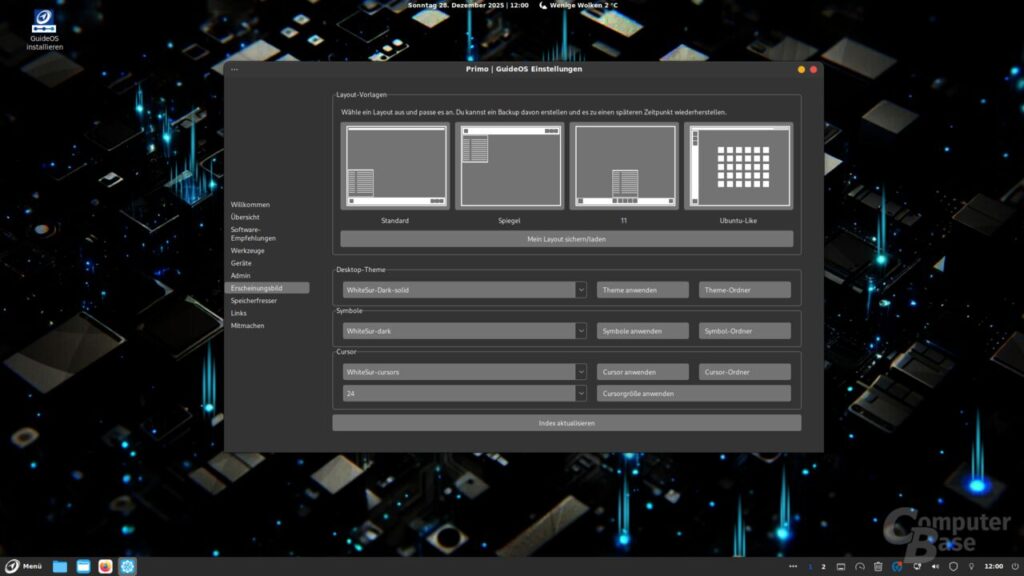
GuideOS is a German Linux distribution, created from the community of Linux Guides. Technically, the whole thing is based on Debian, and the compilation of the operating system is created on the basis of community feedback. A special feature of the distribution is its own control center PRIMO. This makes it easy to manage software. The appearance of Linux, which is equipped with the Cinnamon desktop, can also be changed via the central software. An overview tab shows the current system load and memory usage. “Tools” link directly to important system settings. A device tab also provides a quick overview of, for example, connected USB and PCI devices. But also common admin commands such as the update via apt or Flatpak are available with one click. The listing of “memory eaters” on the system is also convenient. Version 1.0 is available for download on the project page.
CachyOS Announces Server Edition
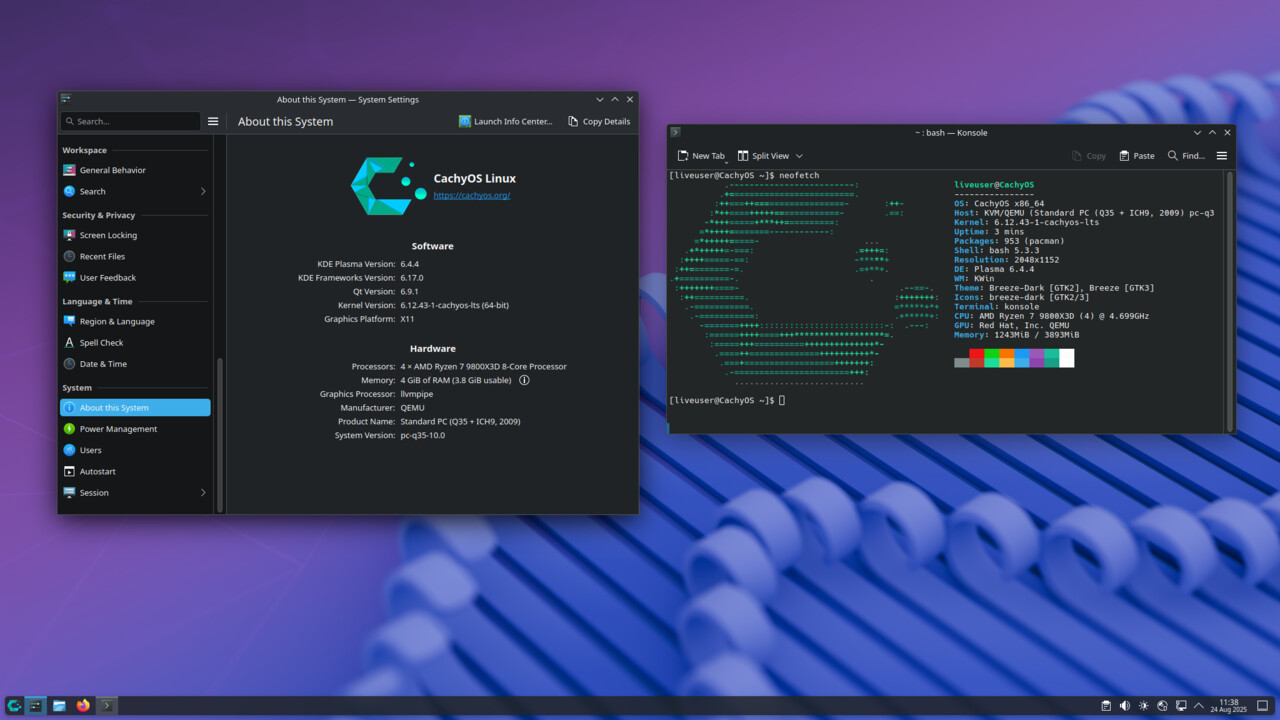
The developers of Cachyos have shared the state of development with the community in an annual summary. In addition to the announcement of new sponsors, such as Framework and an expansion of the team, the announcement of a server edition was also surprising for some. This is intended for NAS, workstations and servers. Hosting providers should be given the opportunity through a verified image to be able to provide users with a ready-made Cachyos installation with just a few clicks.
New development of the X11 server started
As Phoronix reports, developers have started work on a new X11 server called Phoenix. The goal of the whole should be a modern replacement, with full compatibility of the X11 protocol. The use of the Zig programming language is interesting at this point. As a result, the new development should already be safer than the old X11 by itself, but new features such as HDR and VRR should also be introduced. But at the current time, Phoenix is not really usable, only the simple display of some windows is possible.
X11Libre is making progress
If you are dependent on X11 or can’t do anything with Wayland, you don’t necessarily have to wait for the development of a new X11 server. The X11Libre project has set itself the goal of further developing the X11 server. The code is cleaned up, simplified, new features are introduced and compatibility with new drivers is ensured. The project on GitHub currently has hundreds of contributors and thousands of pull requests. With version 25.1.0, more than 1,400 changes have been incorporated since the last release.
